
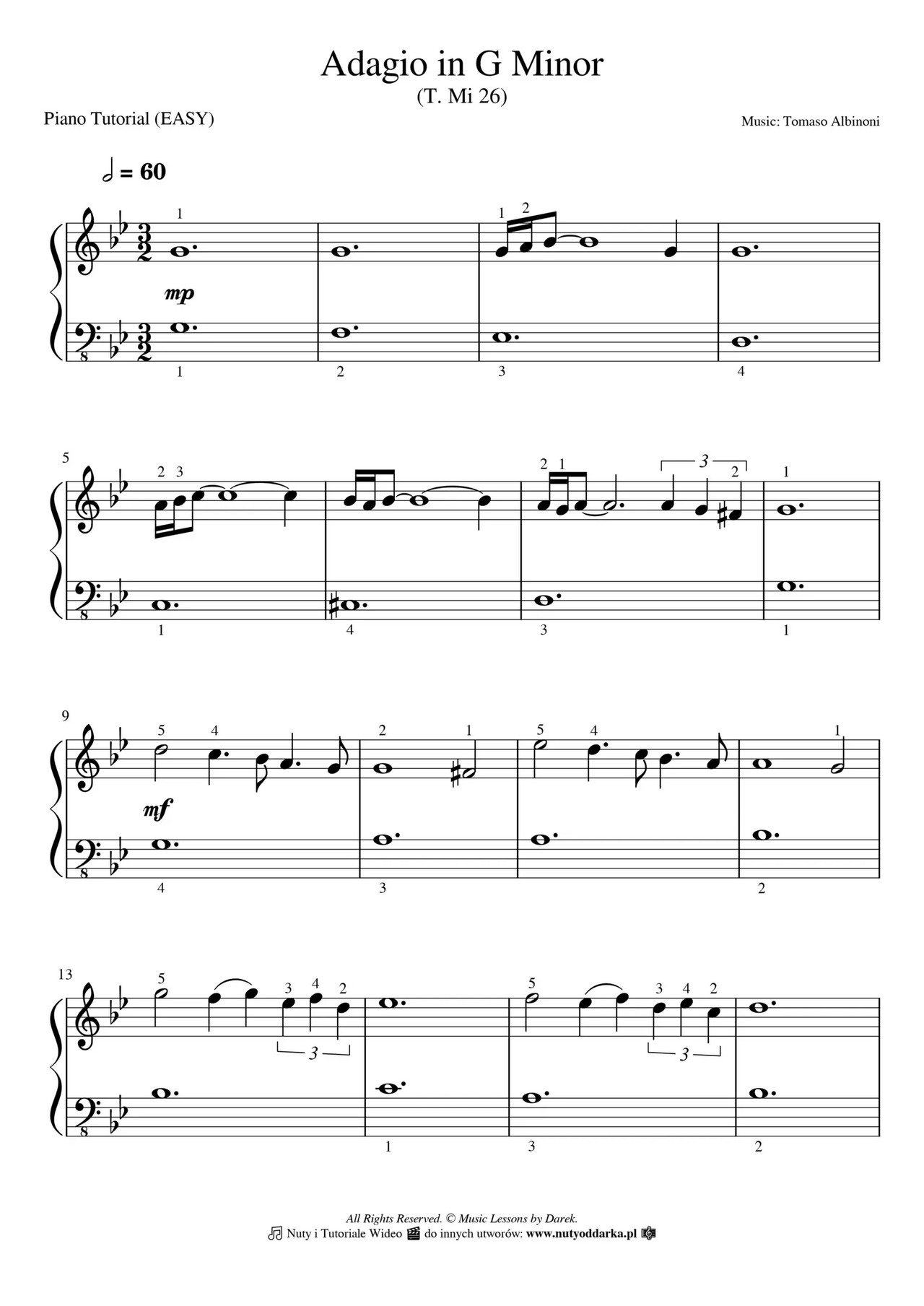
Adagio in G minor

Dkendzior · CC0
In fact, the work was composed by the 20th-century musicologist and Albinoni biographer Remo Giazotto, who claimed it was based on a manuscript fragment containing a bass line by Albinoni.
- Composer
- Remo Giazotto (attributed to Tomaso Albinoni)
- Field
- Neo-Baroque composition
- Nationality
- Italian (Giazotto); Venetian (Albinoni)
- Known for
- Often misattributed to Albinoni; subject of scholarly debate over authenticity
Lore & Background
The piece is frequently referred to as 'Albinoni's Adagio' or 'Adagio in G minor by Albinoni, arranged by Giazotto.' The ascription to Albinoni rests upon Giazotto's purported discovery of a manuscript fragment consisting of a few opening measures of the melody line and basso continuo portion from a slow second movement of an otherwise unknown Albinoni trio sonata. 4 set.
Reader's Guide
The Adagio in G minor holds significance as a widely performed and recorded piece that has permeated popular culture, appearing in films, television, advertisements, and albums from the 1960s onward. Its legacy is complicated by persistent scholarly debate over the existence of the Albinoni manuscript fragment, with some viewing the affair as a musical hoax perpetrated by Giazotto. There is no dispute that everything in the Adagio other than the bass line was composed by Giazotto, and his authorship of those parts is not contested. The piece is most commonly orchestrated for string ensemble and organ, or string ensemble alone, and has been transcribed for other instruments.
Did You Know?
- Giazotto never produced the manuscript fragment, and no official record of its presence in the Saxon State Library collection has been found.
A Vow, a Bride, and a Salzburg Premiere
Mozart set pen to paper on this grand mass during 1782 and 1783, a period when he had recently settled in Vienna after leaving his native Salzburg and had just married Constanze. A letter he sent to his father Leopold on 4 January 1783 references a personal vow to compose a mass upon bringing his then-fiancée to Salzburg, yet musicologist Ulrich Konrad has cautioned that this single document does not unambiguously confirm such a motivation, and no other authentic source corroborates the theory. The work's world premiere arrived on 26 October 1783 at Saint Peter's Abbey in Salzburg, where Mozart had returned with Constanze—neither of them having yet met his father or his sister Nannerl. Sensing an opportunity, Mozart shaped the demanding coloratura of the soprano arias, particularly "Christe" and "Et incarnatus est," to showcase Constanze's vocal brilliance before her in-laws. A rehearsal took place at the nearby Kapellhaus three days earlier, and the ensemble comprised the full Hofmusik employed by Prince-Archbishop Colloredo. The program encompassed the Kyrie, Gloria, Sanctus, and Benedictus.
An Incomplete Legacy and Two Centuries of Completion
One of the most enduring puzzles surrounding this mass is its fragmentary state. The Credo breaks off after the "Et incarnatus est" aria, with only two Credo movements surviving and their orchestrations incomplete, while the entire Agnus Dei is absent. The Sanctus and Benedictus also suffer from partial losses that demand editorial reconstruction. Over more than a century, at least ten different scholars and composers have attempted to address these gaps, each taking a distinct philosophical approach. Figures such as H. C. Robbins Landon, Helmut Eder, Franz Beyer, Richard Maunder, and Clemens Kemme focused on supplying the missing choral and orchestral textures within the surviving framework. In contrast, Georg Alois Schmitt, Philip Wilby, and Robert Levin went further, either borrowing movements from other Mozart masses or composing entirely new material for the Credo and Agnus Dei through parody and elaboration of period sketches. Benjamin-Gunnar Cohrs and Robert Xavier Rodriguez offered more targeted solutions, providing a complete Credo or an Agnus Dei respectively. Meanwhile, Mozart himself repurposed the Kyrie and Gloria for his cantata Davide penitente, K. 469, adding two new arias and a fugue cadenza.
Orchestral Grandeur and the Salzburg-Haydn-Bach Lineage
As a missa solemnis, the work demands a substantial ensemble: two soprano soloists, a tenor, a bass, double chorus, and a large orchestra comprising flute (deployed solely in the "Et incarnatus est"), two oboes, two bassoons, two horns, two trumpets, three trombones, timpani, organ, and full strings. This instrumentation reflects the pomp and solemnity characteristic of Salzburg's liturgical traditions, yet the mass simultaneously gestures forward toward the symphonic masses that Joseph Haydn would later champion, particularly in its inventive interplay between solo voices and choral forces. Mozart was actively studying the works of Bach and Handel during this period, guided by the patronage and encouragement of Gottfried van Swieten, and the influence of those Baroque masters is audible in the contrapuntal density and dramatic architecture of the scoring. The unusual orchestral coloring—such as the flute, oboe, and bassoon accompanying the "Et incarnatus est" cadenza—reveals a composer who treated the orchestra not as mere accompaniment but as an equal dramatic partner, a sensibility that would define his later symphonic and operatic output.
From Salzburg's Chapel to the Proms and the Recording Studio
The mass has enjoyed a remarkable afterlife in both live performance and recorded sound. In 2016, the Helmut Eder reconstruction received its first appearance in The Proms series at London's Royal Albert Hall, performed by the BBC Scottish Symphony Orchestra and BBC Symphony Chorus under Ilan Volkov, with soloists Louise Alder, Carolyn Sampson, Benjamin Hulett, and Matthew Rose. The discography stretches back to 1959, when Ferenc Fricsay led the Berlin Radio Symphony Orchestra in a Deutsche Grammophon recording featuring Maria Stader and Hertha Töpper. Subsequent landmark interpretations include Sir Colin Davis with the London Symphony Orchestra (1971), Raymond Leppard with Kiri Te Kanawa (1974), Sir Neville Marriner with the Academy of St. Martin in the Fields (1979), Herbert von Karajan with the Berliner Philharmoniker (1981), John Eliot Gardiner with the English Baroque Soloists (1986), Robert Shaw with the Atlanta Symphony (1988), and Peter Neumann with the Collegium Cartusianum (1989), each bringing a distinct interpretive lens to Mozart's unfinished masterpiece.
Gallery

Frequently Asked Questions
Who actually composed Adagio in G minor?
The piece was written by Italian musicologist Remo Giazotto in the 20th century, though it has long been credited to the Venetian Baroque composer Tomaso Albinoni. Giazotto claimed he reconstructed it from a manuscript fragment containing an Albinoni bass line, but scholars remain divided on how much of the upper voices are genuinely Albinoni's.
What style or genre does Adagio in G minor belong to?
It sits in the Neo-Baroque tradition, blending the ornamental textures and modal harmony of the 18th century with 20th-century compositional sensibilities. Its slow tempo, flowing melodic lines, and harmonic progressions make it a staple in music theory classrooms for illustrating Baroque-era voice leading.
Why is Adagio in G minor so controversial among music scholars?
The core dispute centers on whether Giazotto merely transcribed an Albinoni fragment or composed the upper voices himself and presented the result as a reconstruction. Because no complete Albinoni autograph of the piece has ever surfaced, many musicologists treat it as a Giazotto composition that borrows a bass line rather than a lost Baroque masterwork.
Why does Adagio in G minor matter in music theory and composition studies?
It serves as a vivid case study in how attribution, manuscript evidence, and cultural memory shape our understanding of a composer's output. Students also use it to analyze Neo-Baroque harmonic language, counterpoint, and the emotional rhetoric of slow dance forms.
What is the story behind Adagio in G minor's creation?
Giazotto told the story that he found a partially destroyed manuscript in a Munich archive, identified the surviving bass line as Albinoni's, and filled in the missing upper parts himself. The narrative is compelling but unverified, and the piece's afterlife as a 'lost Albinoni' has made it one of the most recorded and misattributed works in the classical repertoire.
More in Music Theory & Composition 1-20
Spotted an error? Know more?
This is a living reference — every entry is fact-audited, and reader corrections feed straight into our audit queue. Suggest an edit · See this site's audit record