
Tonality
System of musical organization centered on a tonic.

IrinaSkvo · CC BY-SA 4.0
Tonality is a concept in music theory that describes the perceived key or mode of a piece, centering around a tonic note and chord where the music is most stable. It is indicated by clues such as a key signature or chord function, and is fundamental to understanding much of Western music from the common practice period to modern popular music.
- field
- Music theory
- known_for
- System of musical organization centered on a tonic note and chord
- related_terms
- Major–minor tonality, harmonic tonality, diatonic tonality, functional tonality
Lore & Background
Although Fétis used it as a general term for a system of musical organization and spoke of types de tonalités rather than a single system, today the term is most often used to refer to major–minor tonality, the system of musical organization of the common practice period. Major–minor tonality is also called harmonic tonality, diatonic tonality, common practice tonality, functional tonality, or just tonality. At least eight distinct senses of the word 'tonality' have been identified, some mutually exclusive. The word may describe any systematic organization of pitch phenomena in any music at all, including pre-17th century western music and much non-western music, such as music based on the slendro and pelog pitch collections of Indonesian gamelan, or the modal nuclei of the Arabic maqam or the Indian raga system.
Reader's Guide
Tonality is a foundational concept in music theory, providing a framework for understanding how pitch relationships create a sense of stability and direction in music. Its significance lies in its role as the organizing principle behind most Western music from the 17th to early 20th centuries, as well as its influence on jazz and popular music. The concept is not monolithic, however, as it has been defined in multiple, sometimes conflicting ways, ranging from a synonym for 'key' to a broader system encompassing non-Western and pre-modern music. The article notes that by the mid-20th century, it became evident that triadic structure does not necessarily generate a tone center, and that non-triadic formations can function as referential elements. Tonality's legacy includes its use in analyzing and composing music across genres, from simple folk songs to orchestral works, and its contrast with atonal and modal systems.
Did You Know?
- At least eight distinct senses of the word 'tonality' have been identified, some mutually exclusive.
- Tonality can describe pitch organization in non-Western music such as Indonesian gamelan (slendro and pelog) and Arabic maqam or Indian raga systems.
- In some languages, the word for 'key' and that for 'tonality' are the same, e.g., French tonalité.
The Architecture of Stability
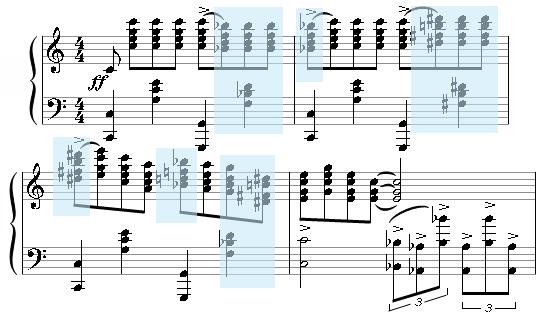
At its heart, tonality is the listener's sense of where a piece of music lives—the perceived key or mode that gives a composition its gravitational center. This center is anchored by a tonic note and its corresponding chord, the point of maximum stability around which everything else orbits. In C major, that anchor is the note C and the triad built from C, E, and G. In B Lydian, the tonic shifts to B, with its major triad of B, D-sharp, and F-sharp. Key signatures and the functional roles of individual chords serve as navigational clues that help listeners lock onto this center. In straightforward genres—folk melodies, orchestral works, pop tunes—the tonic note often bookends the piece, appearing at both the opening and the close. The dominant-to-tonic resolution, whether through a plain dominant chord or a dominant seventh, functions as a powerful cadential gesture that reinforces the listener's sense of home. Even jazz harmony, while not uniformly bound by these rules, borrows certain tonal habits from the European common-practice tradition.
A Word in Search of Its Meaning
The label tonality has a tangled genealogy. The French term tonalité is credited to Alexandre-Étienne Choron, and François-Joseph Fétis adopted it in 1840 as a broad umbrella for any system of musical organization, even speaking of multiple types de tonalités rather than one unified framework. Yet musicologist Carl Dahlhaus argued the word was actually first coined by Castil-Blaze back in 1821. Over time, the term narrowed in common usage to point specifically at major-minor tonality, the pitch system that dominated the common-practice era. That same system goes by several other names: harmonic tonality (a rendering Dahlhaus used from the German harmonische Tonalität), diatonic tonality, functional tonality, common-practice tonality, or simply tonality. In some languages, the word for key and the word for tonality are identical, as in French, where tonalité covers both. This linguistic overlap reflects how deeply the concept of a single governing key has seeped into everyday musical vocabulary, even though the theoretical landscape is far messier than the word suggests.
Eight Ways to Say One Thing
Scholars have identified at least eight distinct, sometimes mutually exclusive, senses in which tonality and its adjective tonal are deployed. In one broad reading, the term covers any systematic organization of pitch in any musical culture—Indonesian gamelan built on slendro or pelog collections, Arabic maqam, Indian raga, or even the 144 basic transformations of twelve-tone technique. In another, tonality is a purely theoretical, pre-compositional arrangement of pitches, a Platonic abstraction that exists before any note is written down. A third sense draws a hard line: tonal music is discontinuous from modal music before 1600 and atonal music after 1910. Yet a fourth, more historical reading treats pre-modern and post-1600 music as continuous, differing in emphasis rather than kind. Additional senses include tonality as a referential tonic organizing harmonies and cadences, as a psychophysical category through which listeners pre-interpret pitches (hearing 440 Hz not as a frequency but as the dominant in relation to D), as a simple synonym for key, and as a loose grab-bag of tonal-harmony ideas. Composer-theorist George Perle insisted tonality is not reducible to tone-centeredness or to any single pitch hierarchy.
Ideology, History, and the Edge of Tonality
Tonality has never been a neutral concept. Schoenberg, for instance, leaned on the idea of progressive development in musical resources to fold the divergent compositional practices of the fin-de-siècle into a single historical narrative—one in which his own music closes one era and opens the next. From that vantage, twelve-tone music could be framed either as the organic culmination of motivic process (Webern's view) or as a dialectical synthesis, an Aufhebung in Adorno's terms, merging late-Romantic motivic practice with a pure-system sublimation of tonality. By the mid-twentieth century, it had become clear that triadic structure does not automatically produce a tone center, that non-triadic formations can serve as referential elements, and that a twelve-tone complex does not rule out tonal centers. Modernistic music, by contrast, was frequently atonal, deliberately breaking from the tonal tradition. Meanwhile, jazz harmony retains certain tonal characteristics inherited from the European common-practice period, even as it departs from them. The result is a concept that is as much a battleground of musical philosophy as it is a descriptive tool.
Gallery


Frequently Asked Questions
What is Tonality in music theory?
Tonality is the organizational framework that gives a piece of music its sense of 'home' by anchoring everything to a central pitch and chord. It acts like a gravitational center, making every other note and harmony feel like it is either moving toward or away from that focal point.
How does Tonality create a sense of stability and tension?
It establishes a tonic—the pitch and chord that feel most resolved and at rest—so that all other harmonies gain their meaning relative to that anchor. The resulting push and pull between tension and release is what makes a progression feel like a journey with a destination.
What are the main related systems or types of Tonality?
The most frequently discussed varieties include major–minor tonality, harmonic tonality, diatonic tonality, and functional tonality. Each highlights a slightly different facet of how the tonic organizes the surrounding pitches and chord relationships.
Why is Tonality considered fundamental to Western music?
From the common-practice era through contemporary popular genres, composers and listeners alike rely on tonal relationships to shape tension, resolution, and emotional direction. Without that shared sense of a home key, most familiar melodies and chord progressions would lose their underlying structural logic.
How can I identify the Tonality of a piece?
Look for clues such as the key signature at the beginning of the staff, the chord that feels most settled at phrase endings, and the functional roles chords play throughout a sequence. Together these signals point you toward the tonic that the entire piece orbits around.
More in Music Theory & Composition 1-20
Spotted an error? Know more?
This is a living reference — every entry is fact-audited, and reader corrections feed straight into our audit queue. Suggest an edit · See this site's audit record