
Time signature
Indicates how many note values fit into each measure.

Dkirk335 · CC0
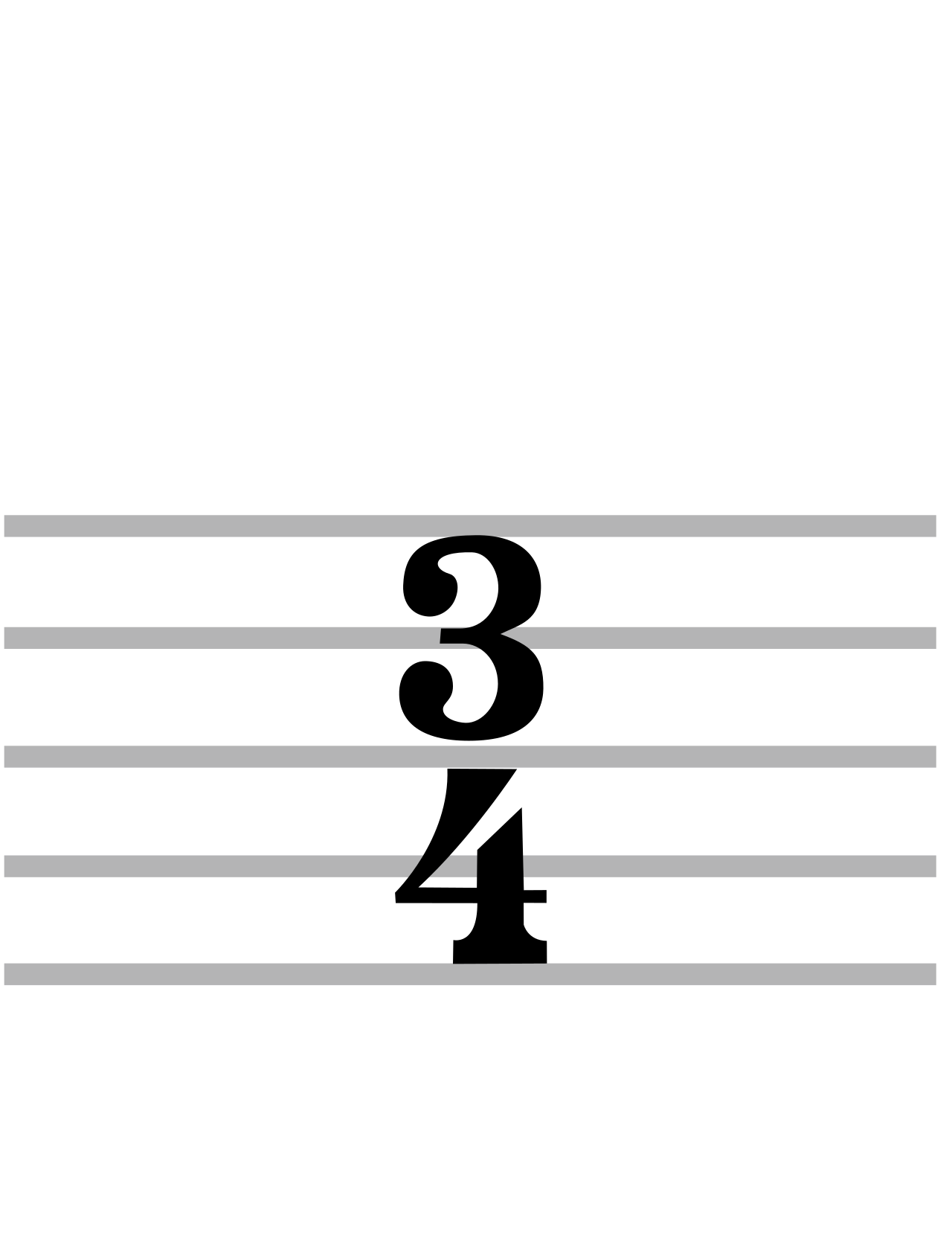
A time signature (also known as meter signature, metre signature, and measure signature) is an indication in music notation that specifies how many note values of a particular type fit into each measure (bar). It indicates the meter of a musical movement at the bar level and appears as two stacked numerals or a time symbol, immediately following the key signature or clef symbol.
- field
- Music notation
- known_for
- Specifying meter and beat grouping in musical scores
- symbolic_forms
- Common time (44) and cut time (22)
Lore & Background
The lower numeral indicates the note value counted, always a power of 2 unless irrational, and the upper numeral indicates how many such values constitute a bar. Symbolic signatures include a symbol for 44 (common time) and a symbol for 22 (alla breve or cut time), derived from mensural time signatures. Simple meters have upper numbers 2, 3, or 4, described as duple, triple, and quadruple meter. In compound meter, the upper number is a multiple of 3, and the lower number is most commonly 8. The beat in simple time usually matches the note value of the signature, while in compound time the beat is typically a dotted note value. The choice of time signature is often a matter of tradition, with particular signatures associated with different music styles. Complex time signatures do not fit simple or compound categories and are called asymmetric, irregular, or odd. They combine both simple and compound beats and are common in some non-Western music, as well as in 20th-century classical and progressive rock. Mixed meters involve frequent changes of time signature, resulting in extremely irregular rhythm.
Reader's Guide
Time signatures are fundamental to Western music notation, providing a framework for organizing rhythm and meter. They specify both the note value that serves as the basic unit and how many such units fill each measure, allowing performers to interpret the pulse and stress patterns of a piece. The distinction between simple and compound meters shapes the feel of music: simple meters group beats in twos or threes, while compound meters group them in threes, affecting how rhythms are perceived and performed. The convention of tempo giusto, dating to the Baroque era, links the bottom number to tempo: larger bottom numbers imply faster tempi, and smaller ones slower tempi. This allows composers to indicate tempo changes through time signature changes rather than separate markings. Complex and irregular meters, though unusual in Western music until the 19th century, have become more common in modern classical and popular music, expanding rhythmic possibilities. The use of additive rhythms in Balkan traditional music further demonstrates the flexibility of time signatures beyond simple and compound categories.
Did You Know?
- The lower numeral in a time signature is always a power of 2 unless the signature is irrational.
- The symbol for common time (44) and cut time (22) derive from mensural time signatures.
- In compound meter, the upper number is a multiple of 3, such as 6, 9, or 12.
- The convention of tempo giusto means the tempo is determined by the natural character of the meter, not that larger bottom numbers correspond to faster tempi.
Defining the Unusual: A Boundary for Metrical Notation
In the study of rhythmic structure, a clear dividing line separates the familiar from the unusual. A time signature is considered unusual whenever it falls outside the standard simple meters built on top numerals of two, three, or four paired with bottom numerals of two, four, or eight, and outside the standard compound meters built on top numerals of six, nine, or twelve paired with bottom numerals of four, eight, or sixteen. Everything beyond that boundary—eleven beats, fourteen beats, eighteen beats, or any other combination—enters the territory of unusual time signatures. The compositions catalogued under this heading span an extraordinary range of genres and eras, from Baroque keyboard pieces by Couperin to contemporary works by composers such as Kyle Gann, Andrew Violette, and Claude Vivier. What unites them is a deliberate departure from the metrical grids most listeners internalize, pushing performers and audiences to reorganize their sense of pulse and expectation with every new bar.
Notational Freedom and the Composer's Hand
Musical notation is not a single fixed language; the same piece of music can be written in more than one way. The particular time signature a composer or transcriber selects is shaped by musical context, individual aesthetic preference, and even the visual layout of the score on the page. Historically, publishers often chose a specific signature to give performers an immediate visual cue about tempo, particularly in the slow movements of symphonies, sonatas, and concerti. A striking illustration of notational flexibility appears in Benjamin Britten's opera Peter Grimes. The Passacaglia in that work is built on a recurring bass line of eleven beats, yet it is notated in ordinary four-four time. Each variation therefore spans two and three-quarter bars, and every new variation begins one crotchet earlier in the bar than the one before it, creating a subtle rotational drift that a straightforward eleven-beat signature would have rendered more obvious.
Eleven and Twelve Beats: A Survey Across Centuries
The upper numerals eleven and twelve appear with remarkable frequency across the catalogue of unusual meters. In eleven time, Edward Elgar's Enigma Variations (Variation VII) and Alexander Borodin's Symphony No. 2 (whose second movement is marked Prestissimo in eleven, with a contrasting trio section in six-four) stand alongside twentieth-century works by Pierre Boulez (the third movement of Pli selon pli), Karlheinz Stockhausen (Mixtur), Henry Cowell (the first two movements of Rhythmicana), and Easley Blackwood Jr. (String Quartet No. 2). Twelve time is equally widespread: Aaron Copland's Appalachian Spring, Béla Bartók's Mikrokosmos Canon No. 60 and String Quartet No. 1, Arnold Schoenberg's Fünf Klavierstücke Op. 23, Anton Webern's Quartet Op. 22, Leoš Janáček's operas Káťa Kabanová and Mladi, Francis Poulenc's 8 Nocturnes and Rapsodie nègre, and Alexander Scriabin's Piano Sonata No. 5 (bars 251 through 262) all feature this signature. The breadth of composers, from Couperin to Adès, underscores how deeply embedded these meters are in the concert repertoire.
Fourteen and Eighteen Beats: Pushing Metrical Complexity Further
As the upper numeral climbs to fourteen and eighteen, the metrical demands on performer and listener intensify considerably. Fourteen time appears in Igor Stravinsky's Petrushka and his Concerto for Piano and Wind Instruments, in Maurice Ravel's Tzigane, in Iannis Xenakis's Metastaseis (across the first hundred and three bars), and in multiple works by Franz Liszt, including his Fantasy on Themes from Mozart's Figaro and Don Giovanni (S. 697) and the Valse à capriccio sur deux motifs de Lucia et Parisina (S. 401). Bartók's Mikrokosmos piece No. 143, Divided Arpeggios, is written for one bar in fourteen time, though it is incorrectly printed as twelve. Eighteen time, rarer still, surfaces in Thomas Adès's Alchymia (a measure combining four-four and eighteen), George Rochberg's Caprice Variations (variation 19), Émile Jaques-Dalcroze's Caprice No. 9, and Percy Grainger's Lincolnshire Posy (fifth movement). These extreme signatures represent some of the most demanding rhythmic landscapes in the written musical record.
Gallery




Frequently Asked Questions
What is a Time signature in music notation?
A time signature is the notational cue that tells you exactly how many beats of a given note value fit inside each measure (bar) of a piece. It defines the meter at the bar level and sets the rhythmic skeleton for the entire movement.
Where does Time signature sit on the musical staff?
It appears as two stacked numerals (or a special symbol) placed immediately after the clef and key signature at the start of a line. This position means the reader encounters it before any notes, so the meter is established before the first beat sounds.
What are Time signature's most recognizable symbolic forms?
The two classic symbols are "common time," written as a bold C with a vertical stroke (equivalent to 4/4), and "cut time," written as a C with a vertical slash (equivalent to 2/2). Both let composers avoid writing out the full pair of stacked numbers.
How does Time signature control beat grouping for a performer?
The upper numeral states how many beats occupy one bar, while the lower numeral names which note value receives a single beat. Together they tell the musician where the downbeat lands and how to feel the pulse within each measure.
Why is Time signature essential for both composers and performers?
Without it, there is no unambiguous guide to where a new measure begins or how many pulses to group before the next downbeat. It is therefore a foundational element that makes written rhythm interpretable and reproducible across performances.
More in Music Theory & Composition 1-20
Spotted an error? Know more?
This is a living reference — every entry is fact-audited, and reader corrections feed straight into our audit queue. Suggest an edit · See this site's audit record