
Tritone
A dissonant interval of three whole tones, historically called the devil in music.

Ank Kumar · CC BY-SA 4.0
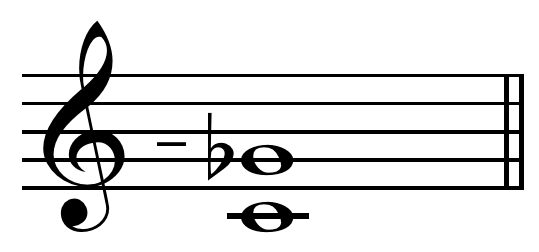
A tritone is a musical interval spanning three whole tones, such as F–B. In 12-tone equal temperament, it divides the octave exactly in half, making it six semitones or 600 cents. It is considered a harmonic and melodic dissonance in traditional functional harmony, often pushing toward resolution, but can also be used to avoid tonality.
- definition
- Interval of three whole tones or six semitones
- narrow_definition
- Only augmented fourths (A4) are tritones
- broad_definition
- Includes augmented fourths, diminished fifths, and rarer intervals
- dissonance
- Classed as a dissonance from early Middle Ages through common practice period
- nickname
- Diabolus in musica ('the Devil in music')
- resolution
- Augmented fourths resolve outward; diminished fifths resolve inward
Lore & Background
The tritone has been regarded as a restless and unstable interval since the early Middle Ages. Guido of Arezzo's hexachordal system suggested avoiding the F–B tritone by moving the hexachord to C. Later theorists like Ugolino d'Orvieto and Tinctoris advocated including B♭. The term 'diabolus in musica' has been applied to the tritone from at least the early 18th century, though earlier references associate it with the minor second or chromatic clashes.
Reader's Guide
The tritone's significance lies in its dual role as both a driving force in tonal harmony and a tool for avoiding tonality. In traditional functional harmony, tritones in dominant seventh chords, diminished triads, and half-diminished or fully diminished seventh chords push toward resolution. Composers like Reginald Smith Brindle noted that introducing a note three whole tones from the key note can prevent tonality from emerging. The interval's dissonant character has made it a subject of theoretical debate, with ratios such as 45/32 or 64/45 assigned depending on context, and Harry Partch criticized the use of large-number ratios for the tritone. Its nickname 'diabolus in musica' reflects historical unease, though the exact origin of the term is uncertain.
Did You Know?
- The tritone divides the octave exactly in half, spanning six semitones or 600 cents in 12-tone equal temperament.
- In the C major scale, the only tritone under the narrow definition is F–B, composed of three major seconds.
- Fully diminished seventh chords are composed of two superposed tritones a minor third apart.
The Narrow and Broad Definitions
The tritone's identity has long been a point of theoretical contention. Under the narrow interpretation, only augmented fourths qualify as true tritones, because each of the three constituent whole tones must be a diatonic step. In C major, this means F–B is the sole tritone per octave, since it decomposes into three major seconds (F–G, G–A, and A–B). Its inversion, B–F, fails this test because three major seconds above B lands on E♯, not F. The broad interpretation, by contrast, embraces any interval spanning six semitones, regardless of spelling. Under this wider lens, a diatonic scale yields two tritones per octave—F–B and B–F in C major—and even rarer spellings such as doubly augmented thirds or doubly diminished sixths can be classified as tritones. The augmented fourth itself is produced by widening a perfect fourth by one semitone while keeping the letter names unchanged, and the diminished fifth is created by narrowing a perfect fifth by one semitone under the same constraint.
Tritones in Tonal Harmony and Their Resolution
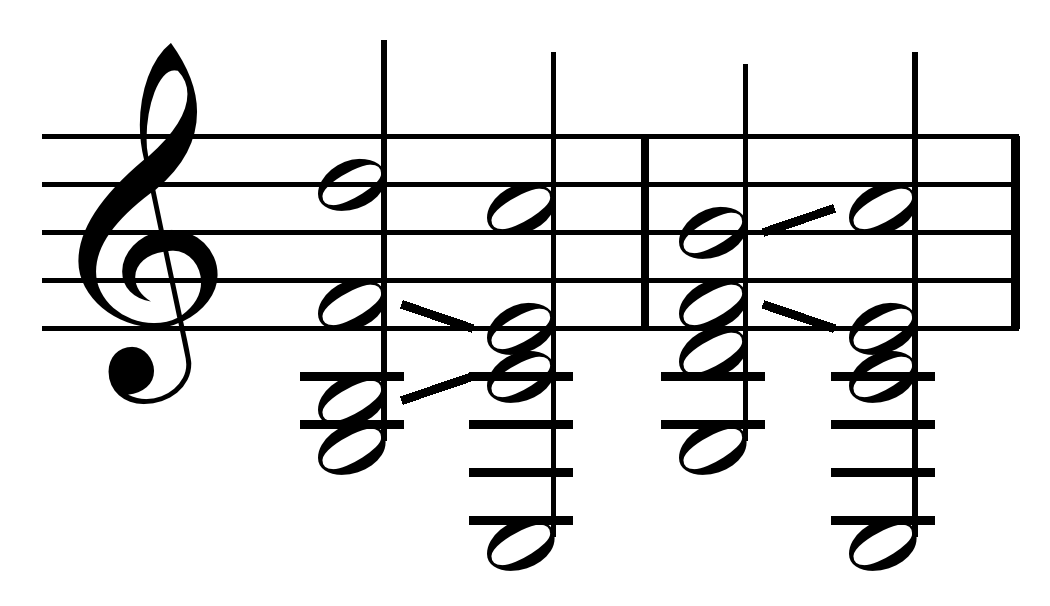
In traditional functional harmony, the tritone acts as a powerful engine of directed motion. Dominant seventh chords carry a diminished fifth between their third and seventh, while diminished triads place a tritone between root and fifth. Half-diminished seventh chords share that same interval, and fully diminished seventh chords are built from two tritones stacked a minor third apart. Augmented sixth chords introduce the tritone spelled as an augmented fourth: the Italian and German sixth each contain one, whereas the French sixth stacks two a major second apart. The resolution rules are precise and directional. Augmented fourths resolve outward to a minor or major sixth, while diminished fifths resolve inward to a major or minor third, typically by step in contrary motion. This obligatory pull toward the tonic is what makes the tritone one of the most tension-laden intervals in Western harmony, and it is precisely the property that Reginald Smith Brindle later turned against tonality itself, noting that a note placed three whole tones from the key note can neutralize any emerging sense of key.
The Diabolic Interval — Dissonance and Expressiveness
The tritone has carried a reputation for instability and even malice that stretches back centuries. Ján Haluska observed that its unstable character sets it apart from other intervals, a point Paul Hindemith explored in his 1945 treatise on composition. Whether expressed as the ratio 64/45 or 45/32 depending on musical context, the tritone is not superparticular, which underscores its unique and uneasy role in the harmonic landscape. Harry Partch sharpened the critique, arguing that the 45/32 ratio, though built from numbers that are multiples of five or under, uses excessively large figures for a five-limit scale. He called this sufficient justification for the epithet "diabolic" long attached to the interval, insisting that only a temperament-perverted ear could prefer 45/32 to a small-number interval of similar width. Partch further argued that theorists had taken a convoluted, roundabout path to an interval that could have been reached more directly through the number seven, bypassing the diabolical construction entirely.
Tritones Across the Scales — Tritonic and Atritonic
Where a tritone appears within a scale depends heavily on which mode is in play. In major scales, the augmented fourth sits between the fourth and seventh degrees, as F–B does in C major. Natural minor scales place a diminished fifth between the second and sixth degrees, exemplified by D–A♭ in C minor. Harmonic minor combines both: the diminished fifth between degrees two and six and the augmented fourth between degrees four and seven. Melodic minor, with its ascending and descending forms, scatters tritones in different positions—ascending, augmented fourths appear between degrees three and six and between four and seven; descending, a diminished fifth reappears between two and six. Supertonic chords drawn from the natural minor mode contain a tritone in every inversion. Scales that contain tritones are termed tritonic, while those that do not are called atritonic, a distinction that highlights how the interval's presence or absence fundamentally shapes the character of a scale.
Gallery


Frequently Asked Questions
What exactly is a tritone?
A tritone is a musical interval spanning three whole tones, equal to six semitones or 600 cents in 12-tone equal temperament. It divides the octave perfectly in half, placing it exactly midway between two notes an octave apart.
Why is the tritone nicknamed 'Diabolus in musica'?
The tritone earned the label 'the Devil in music' because its stark, unstable sound was considered so unsettling in medieval and Renaissance sacred music that composers often avoided it or required special handling. That reputation persisted through the common practice period, where it remained classified as a dissonance demanding resolution.
How does a tritone resolve in traditional voice leading?
An augmented fourth resolves outward—the lower voice descends while the upper voice ascends—whereas a diminished fifth resolves inward, with the upper voice falling and the lower voice rising. The two spellings imply different harmonic functions, so each carries its own prescribed resolution path.
Are all tritones the same, or do different spellings matter?
In the narrow definition, a tritone refers specifically to an augmented fourth, but the broader usage also includes diminished fifths and rarer enharmonic spellings. The distinction is not merely cosmetic: each spelling dictates a different resolution direction within functional harmony.
Why is the tritone considered so important in music theory?
As the only interval that splits the octave into two equal halves, the tritone sits at the heart of harmonic tension and has driven both tonal resolution and the later dissolution of tonality. From Bach's chromatic passages to Debussy's whole-tone explorations, it has served as a structural pivot for composers across centuries.
More in Music Theory & Composition 1-20
Spotted an error? Know more?
This is a living reference — every entry is fact-audited, and reader corrections feed straight into our audit queue. Suggest an edit · See this site's audit record