
Twelve-tone technique
A method ensuring equal use of all twelve chromatic notes.

The original uploader was Hyacinth at English Wikipedia . · Public domain
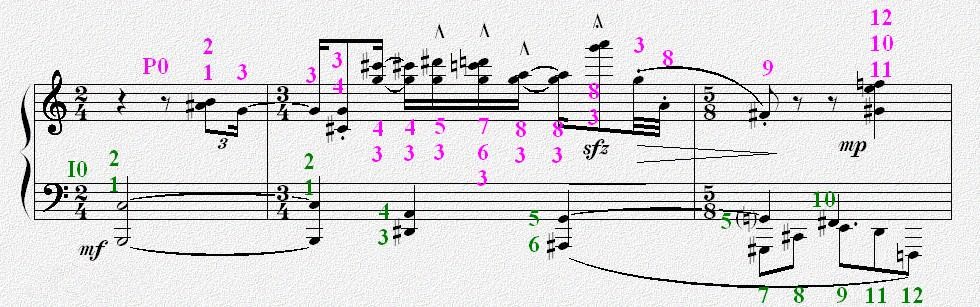
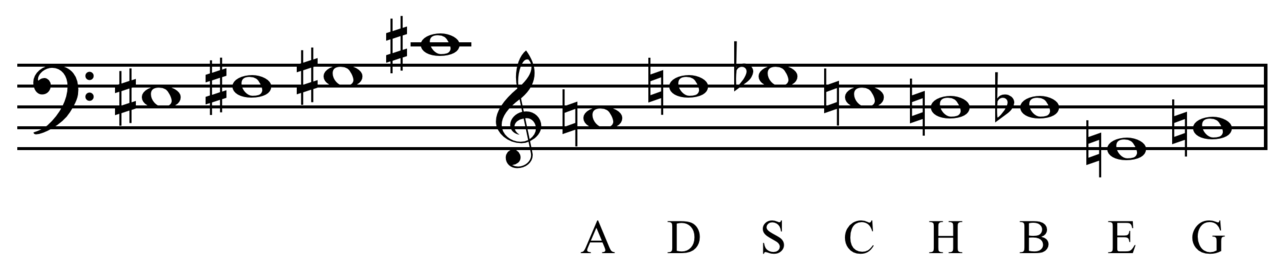
The twelve-tone technique, also known as dodecaphony, twelve-tone serialism, and twelve-note composition, is a method of musical composition that ensures all 12 notes of the chromatic scale are sounded equally often, preventing emphasis on any one note through the use of tone rows.
- field
- Musical composition
- known_for
- Method of composing with twelve tones related only to one another
- associated_school
- Second Viennese School
Lore & Background
The method was used almost exclusively by Second Viennese School composers—Alban Berg, Anton Webern, and Schoenberg—during its first twenty years, though Elisabeth Lutyens also wrote over fifty pieces using the serial method.
Reader's Guide
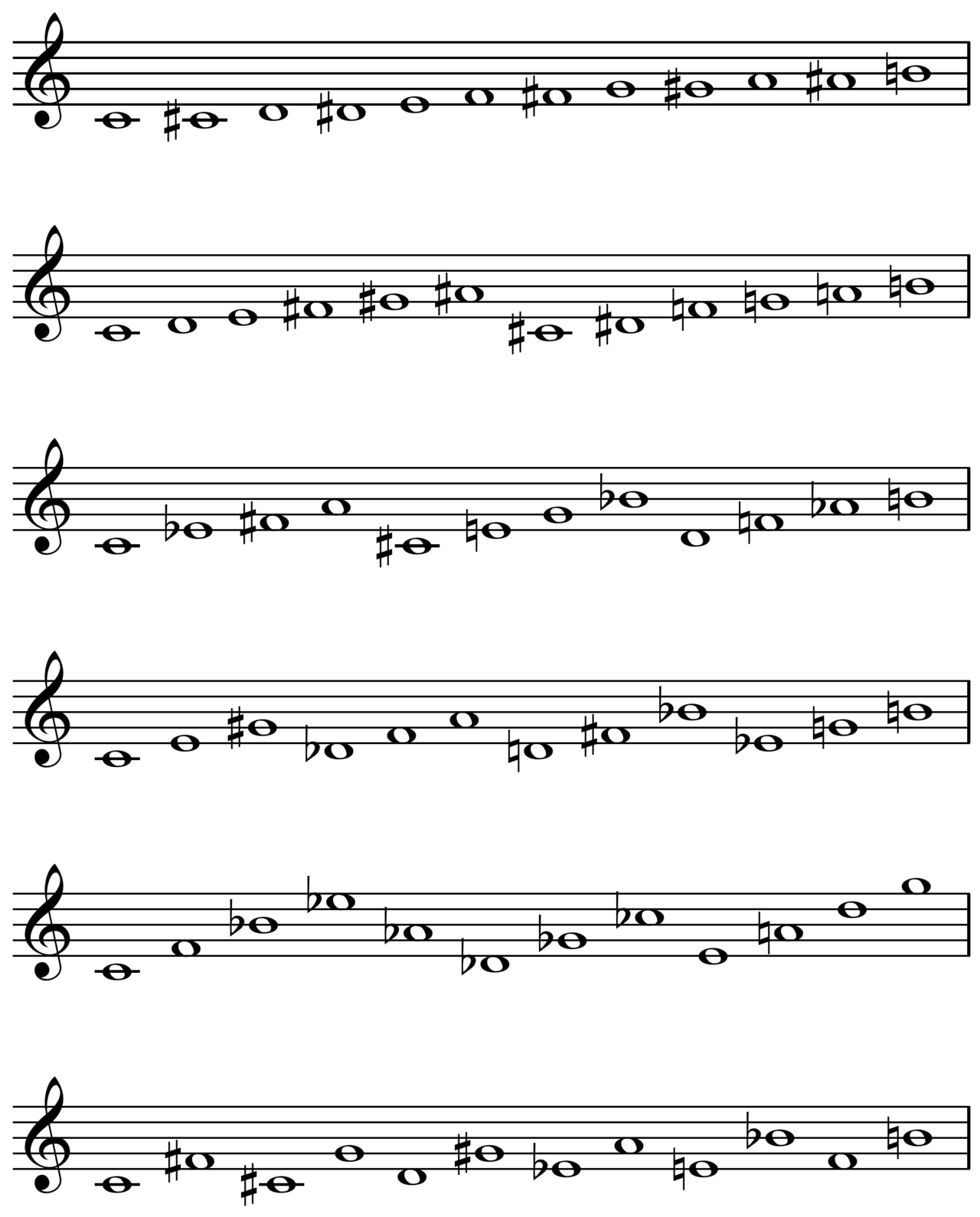
The twelve-tone technique is historically and aesthetically significant as a systematic method for organizing atonal music, replacing tonality with increased thematic unity. Its basis is the tone row—an ordered arrangement of all twelve chromatic notes—subject to transformations of inversion, retrograde, and retrograde-inversion, along with transposition, yielding up to 48 row forms. The technique influenced mid-20th-century composers widely, including those who initially opposed it, such as Aaron Copland and Igor Stravinsky. While Schoenberg's version is considered most significant, Hauer's independent system used unordered hexachords or tropes. The technique's legacy includes its extension into total serialism, controlling multiple musical parameters, and its use in diverse contexts from concert music to cartoon scores.
Did You Know?
- The technique was used almost exclusively by Second Viennese School composers for its first twenty years.
- American composer Scott Bradley used the twelve-tone technique in Tom & Jerry cartoon scores.
- Rock guitarist Ron Jarzombek used a twelve-tone system for Blotted Science's extended play The Animation of Entomology.
The Hauer–Schoenberg Rivalry
The question of who first conceived a systematic method for treating all twelve chromatic pitches as equals has generated lasting scholarly debate. Austrian composer Josef Matthias Hauer published his "law of the twelve tones" in 1919, and his work Nomos, Op. 19, from that same year, used twelve-tone passages to mark out large formal divisions. Arnold Schoenberg recalled first employing the technique in 1921 and explaining it to pupils two years later. In 1923, Hauer reinforced his claim in the second edition of his treatise On the Essence of Music, asserting that atonal melody demands repeated use of all twelve tones. The two approaches differed structurally: Hauer favored unordered hexachords or tropes, while Schoenberg organized his system around a strictly ordered series. Yet musicologist John Covach has challenged this clean division, noting that much of Hauer's output actually relies on ordered series, and that the Second Viennese School's "strict ordering" was in practice softened by the interplay of ordered and unordered pitch collections. Felix Khuner further contrasted Hauer's more mathematical orientation with Schoenberg's instinctively musical one, though both men pursued the same fundamental goal of distributing equal weight across the full chromatic palette.
The Second Viennese School's Monopoly
For roughly the first two decades after the technique's emergence, its use was almost entirely confined to the composers of the Second Viennese School—Arnold Schoenberg, Alban Berg, and Anton Webern. This small circle dominated the practice so thoroughly that the method became virtually synonymous with their collective output. One notable exception was Elisabeth Lutyens, who composed over fifty works employing the serial method during this period. The technique had been preceded by "freely" atonal compositions from 1908 to 1923, which, despite their apparent freedom, often contained an integrative element in the form of a minute intervallic cell that could be expanded or transformed much like a tone row. Individual notes in these earlier works sometimes functioned as pivotal elements, permitting overlapping statements of a basic cell or the linking of multiple cells. The Second Viennese School's approach, while characterized by strict ordering, was inevitably tempered by practical compositional considerations; in reality, they worked on the basis of an interaction between ordered and unordered pitch collections rather than a rigidly mechanical procedure.
Global Adoption and the Serial Expansion
By the 1950s, the twelve-tone technique had escaped its Viennese origins and become a widely influential tool across the international compositional landscape. Composers who had originally resisted or never subscribed to the method—including Aaron Copland and Igor Stravinsky—eventually incorporated it into their own music. A broad roster of mid-century figures, such as Milton Babbitt, Luciano Berio, Pierre Boulez, Luigi Dallapiccola, Ernst Krenek, Riccardo Malipiero, and Bruno Maderna, all took up the technique, and many extended it beyond pitch to govern duration, method of attack, and other musical parameters, producing what is commonly called serial music. Some went so far as to subject every element of a composition to the serial process. In a 1962 interview, Charles Wuorinen observed a telling transatlantic divide: while most European composers claimed to have "gone beyond" and "exhausted" the twelve-tone system, in America the technique had been "carefully studied and generalized into an edifice more impressive than any hitherto known." In popular culture, the method found an unexpected home: American composer Scott Bradley, best known for scoring Tom & Jerry and Droopy Dog cartoons, employed twelve-tone progressions to create what he described as "out-of-this-world" harmonies suited to the fantastical situations of animated storytelling.
Theoretical Foundations and Precedents
Schoenberg himself described his system as a "Method of composing with twelve tones which are related only with one another," and the technique is commonly classified as a form of serialism. Its core philosophical premise, articulated by early proponent Rudolph Reti, was to replace one structural force—tonality—with another, namely increased thematic oneness. Reti argued the method arose from Schoenberg's frustrations with free atonality, offering what he called a "positive premise" for composing without a key. In practical terms, twelve-tone music treats each of the twelve semitones of the chromatic scale with equal importance, in deliberate contrast to earlier classical music, which had privileged certain notes, particularly the tonic and the dominant. Schoenberg's underlying intention was for the technique to replace the structural differentiations formerly provided by tonal harmonies. The method did not emerge from a vacuum: it was preceded by "nondodecaphonic serial composition" in the works of Alexander Scriabin, Igor Stravinsky, Béla Bartók, and Carl Ruggles. Musicologist Oliver Neighbour argued that Bartók was "the first composer to use a group of twelve notes consciously for a structural purpose," doing so in 1908 with the third of his fourteen bagatelles. The technique also shares roots with the ostinato, a pervasive feature of modern musical practice that Schoenberg and Hauer effectively systematized for dodecaphonic purposes.
Gallery

Frequently Asked Questions
Who invented the twelve-tone technique?
Arnold Schoenberg developed the method in the 1920s as a way to structure music without relying on a traditional tonal center. He is the central figure of the Second Viennese School, alongside Alban Berg and Anton Webern, who further developed the approach.
What exactly is the twelve-tone technique?
It is a compositional system in which all twelve notes of the chromatic scale are given equal weight, typically organized into a predetermined sequence called a tone row. This prevents any single pitch from dominating the harmonic landscape.
What other names is twelve-tone technique known by?
The method is also called dodecaphony, twelve-tone serialism, or twelve-note composition. All these terms refer to the same underlying principle of treating the twelve chromatic pitches as equal members of a single series.
Why is the twelve-tone technique important in music history?
It offered composers a rigorous alternative to the centuries-old system of major and minor keys, fundamentally reshaping how atonal music could be structured. Its influence radiated through the Second Viennese School and into much of twentieth-century composition.
How does a tone row work in twelve-tone composition?
A composer selects an ordering of all twelve chromatic pitches and then derives variations—such as inversion, retrograde, and retrograde inversion—to generate melodic and harmonic material. This ensures no note is privileged over another while still providing a coherent structural framework.
More in Music Theory & Composition 1-20
Spotted an error? Know more?
This is a living reference — every entry is fact-audited, and reader corrections feed straight into our audit queue. Suggest an edit · See this site's audit record